Fiji’s Foreign Policy White Paper in 2024 reaffirmed the central position of the Pacific in our foreign policy calculations.
We assessed that Fiji’s most significant threat lies in the prospect of a region which is riven by division, insecurity and instability.
For this, the Ocean of Peace concept is a signal that we seek a region in which strategic competition is managed; where stability is the touchstone of regional relationships; and where coercion is eschewed.
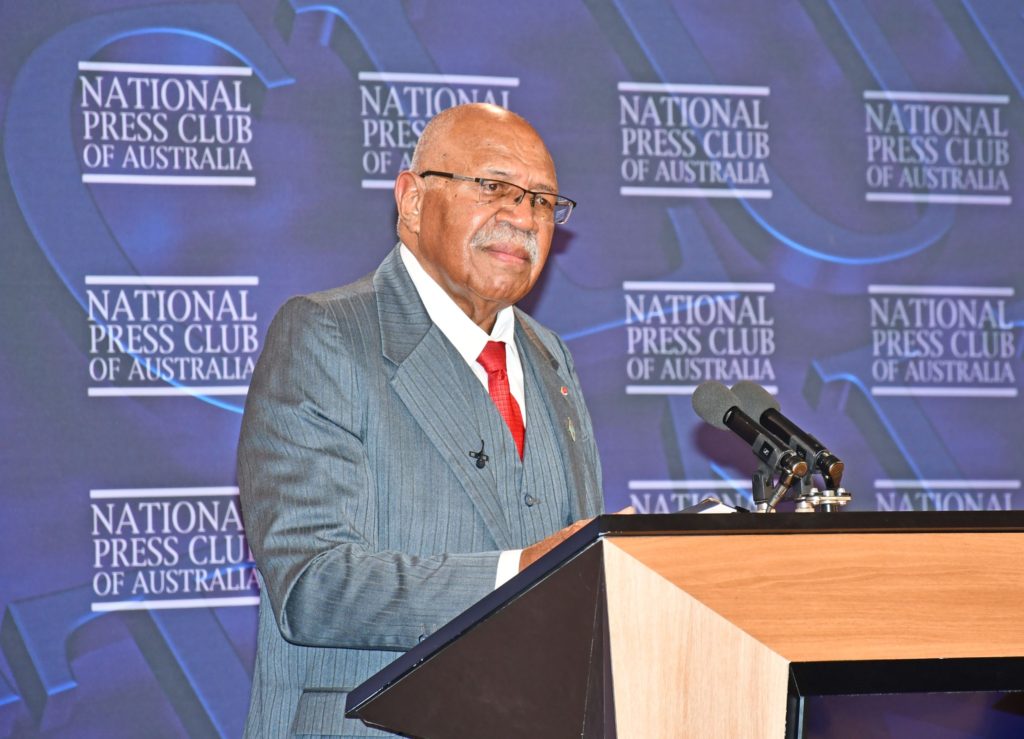
This was the message delivered by Prime Minister Honourable Sitiveni Rabuka while addressing media representatives and dignitaries at a National Press Club luncheon in Canberra yesterday.
Prime Minister Rabuka emphasised that the Ocean of Peace lies at the heart of Fiji’s vision for Pacific security—anchored in unity and strengthened through regional cooperation.
“It offers this generation of Pacific Leaders the opportunity to live up to the goal codified in the Treaty of Rarotonga – to ensure, so far as lies within their power, that the bounty and beauty of the land and sea in their region shall remain the heritage of their peoples and their descendants in perpetuity to be enjoyed by all in peace,” he said.
“The Ocean of Peace concept draws on foundational tenets of Pacific regionalism. It is our opportunity to weave the threads of our Pacific past with our vision for our Pacific future.”
He explained that the Ocean of Peace concept is rooted in core principles of Pacific regionalism and represents a chance to blend the wisdom of the Pacific’s past with its aspirations for the future.
He further announced that work is underway to present the Ocean of Peace Declaration at the upcoming Pacific Islands Forum Leaders Meeting in Honiara, Solomon Islands in September.
In his concluding remarks, Prime Minister Rabuka urged the people of the Pacific and partners to unite under the Ocean of Peace concept to promote regional peace, security and cooperation.
“The Ocean of Peace can also offer a platform to expand for a global audience, concepts central to the Pacific Way, including to articulate how those within and beyond the Blue Pacific can embrace opportunities to work together and resolve differences respectfully and with understanding,” stated the Prime Minister.
“There is no greater acknowledgment of the pivotal role that Pacific ways of life and values play in fostering peace than that articulated in Chapter 6 of the UN Charter, which mandates parties to disputes to pursue a “pacific settlement of disputes.”
“By the Ocean of Peace, we’re putting a face to that adjective – pacific – we’re the Pacific. This principle aligns with the region’s long-standing traditions of peace-building through dialogue, consensus, and communal restoration,” he concluded.