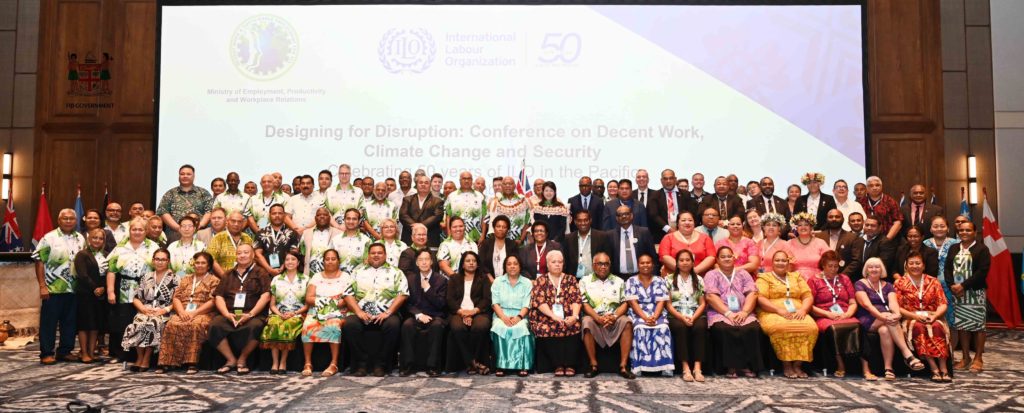
Prime Minister Sitiveni Rabuka officiated at the inaugural Pacific Regional Tripartite Conference & 50th Anniversary of the ILO in the Pacific in Nadi, welcoming regional leaders, employers, workers, and development partners to what he described as a “historic milestone” for the Pacific held in Nadi today.
The gathering marked not only the beginning of a new chapter in employment cooperation across the region but also the celebration of 50 years of enduring partnership between the Pacific and the International Labour Organization (ILO).
“This conference is more than a meeting—it is a commitment to future generations. Employment, security, labour mobility, and climate resilience are interconnected forces shaping the future of our Blue Pacific. We must respond together, as one Pacific family,” the Prime Minister said.
Prime Minister Sitiveni Rabuka reaffirmed the spirit of Vuvale — the Pacific family — which underpins the regional approach to shared challenges. He said the ILO’s principle of tripartism, bringing together governments, employers, and workers, has been the foundation of resilient and inclusive development in the Pacific.
“Over the past five decades, the ILO has stood with us, supporting skills development programmes, legal reforms, social protection, and workplace safety,” he said. “That legacy gives us the confidence to face today’s challenges — climate change, digital disruption, and labour mobility — not in isolation, but through collective and coordinated action.”
The Prime Minister stressed that the Pacific is at a pivotal moment, with employment, security, climate change, and labour mobility closely linked.
He cited the ILO’s projection that heat stress alone could result in the loss of 136 million jobs globally, noting the devastating implications for Pacific communities already losing livelihoods to climate change.
“Labour mobility provides vital remittances but also creates vulnerabilities when skilled workers are lost at home,” he explained. “At the same time, new security challenges are reshaping the very nature of work, requiring skills in climate engineering, digital security, and ocean governance. These are the jobs of tomorrow, and they demand bold investment today.”
The Prime Minister highlighted the Pacific’s stewardship of nearly 20 per cent of the world’s ocean, calling for employment strategies that link ocean protection with sustainable livelihoods.
A major outcome of the conference is the launch of the Regional Permanent Secretary Employment Talanoa Forum and its Technical Working Group.
He said the forum will serve as a commitment mechanism — ensuring dialogue leads to action, with regular meetings, open reporting, and accountability.
“Talanoa is a uniquely Pacific process of dialogue rooted in respect, inclusion, and consensus. It aligns with the ILO’s tripartite principles and ensures equal participation of governments, employers, and workers,” he said.
The Forum, supported by a dedicated secretariat and resources, will focus on turning regional discussions into tangible policies, solutions, and outcomes for Pacific peoples.
Prime Minister Rabuka outlined Fiji’s vision of an “Ocean of Peace” — a Pacific region anchored in stability, prosperity, and dignity. He said peace cannot exist without decent work, and set out four pillars to guide Pacific labour cooperation:
Employment security as national security – Stable, dignified jobs are the foundation of stable societies.
Climate-resilient livelihoods – The region must transition towards blue-green economies that work with nature.
Regional labour mobility that strengthens all – Migration must benefit the region collectively, not weaken the most vulnerable nations.
Innovation rooted in Pacific values – Technology should empower Pacific peoples while preserving cultural identity.
“Peace cannot thrive on empty stomachs or broken dreams, the Ocean of Peace must be anchored in decent work for all Pacific peoples.”
Aligning with the 2050 Strategy for the Blue Pacific Continent the Prime Minister stated the vision aligns with the 2050 Strategy for the Blue Pacific Continent, which outlines seven interconnected themes: political leadership, people-centered development, peace and security, resource development, climate resilience, ocean stewardship, and digital connectivity.
“These are not abstract policy areas — they are the very foundations of our peoples’ livelihoods,” he said.
The head of government stated key thematic topics:
Green growth and just transition policies to create jobs in renewable energy, sustainable tourism, ecosystem restoration, and disaster preparedness.
Regional labour mobility frameworks that balance remittances with local development, protect workers’ rights, and encourage circular migration.
Technology as an enabler that amplifies Pacific cultures and provides opportunities for youth through digital skills, e-commerce, and remote work.
Inclusive growth ensuring women, youth, persons with disabilities, and indigenous peoples have equal access to decent work.
The Prime Minister highlighted a call to action to all stakeholders:
Governments to commit to regional coordination beyond national borders.
Employers to invest not only in profit but in sustainable, inclusive prosperity.
Workers and Unions to champion adaptation and just transitions.
Development Partners, including the ILO, to support Pacific-led solutions that respect dignity and local leadership.
“Our 50-year partnership with the ILO shows that true collaboration blends technical expertise with respect for Pacific leadership,” he said.
The Prime Minister said the Conference is the beginning of a new era of Pacific regionalism, extending tripartite cooperation into climate resilience, peace, and prosperity.
“The Blue Pacific Continent our children inherit must be more prosperous, peaceful, and sustainable than the one we received. Together, we can make this vision a reality,” he declared.
The four-day event brings together ministers, policymakers, employers, workers, and development partners to chart concrete outcomes in employment, labour mobility, and resilience across the Pacific.